Can you flush the toilet during a power outage?
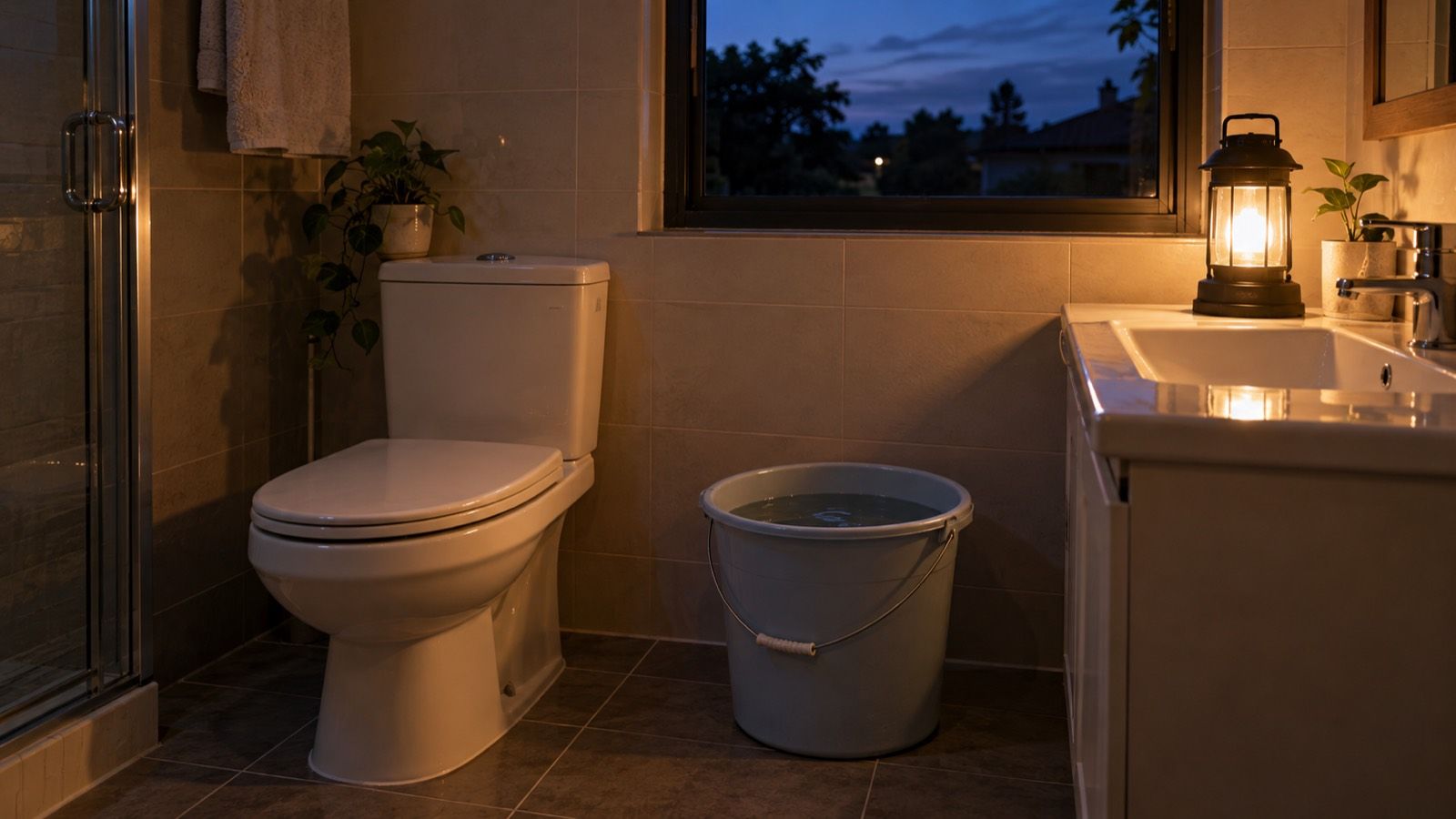
A standard gravity-flush toilet has no electric parts, so it flushes whenever water is in the tank or poured into the bowl. A fast pour of at least 2 US gallons (7.6 L) starts the flush (City of Ivins, Utah). If your sewer main is down or a septic pump has no power, use a bag-lined bucket.
Key facts
| Fact | Value | Source |
|---|---|---|
| Bucket-flush volume | At least 2 gallons (7.6 L), poured quickly into the bowl to start the siphon; a tank can instead be filled to its float and flushed with the lever | City of Ivins, Utah |
| Water a normal flush uses | Single-flush WaterSense toilets use 1.28 US gallons (4.8 L) or less per flush; the federal maximum is 1.6 gallons (6.1 L); inefficient older toilets use up to 6 gallons (22.7 L) | US EPA WaterSense |
| Private well | A well system can lose pressure if faucets are opened in an outage, and the state advises against flushing toilets during extended outages to avoid contamination | Michigan Department of Environmental Quality |
| Sewer main down | If the sewer main is not working, do not flush; sewage can back up into the lowest drains of the house | City of Ivins, Utah |
| Lift stations | Lift stations rely on continuous electrical power; some have only high-level alarms and no automatic backup power | Municipality of the District of West Hants (Nova Scotia) |
| Septic pump breaker | Turn the septic pump breaker off during an outage so the pump does not restart on its own when power returns | King County Public Health, Washington |
| Bucket toilet | Turn off the water valve, line the bowl with a bag inside a second bag, add absorbent material, or use a five-gallon bucket | NC Department of Health and Human Services |
Do toilets flush during a power outage?
A standard gravity-flush toilet flushes during a power outage, because the flush itself uses no electricity. It needs water in the tank or poured into the bowl.
The trouble is everything upstream and downstream of the toilet. Water has to reach the house. Waste has to leave it. Either job can depend on a pump. So the useful question is which pumps your home depends on, and the table below sorts that out.
Can you flush the toilet in a power outage? A table by water and sewer setup
Whether you can flush depends on how water gets in and how waste gets out. Find your setup, then read the matching section.
| Your setup | Can you flush? | What to do |
|---|---|---|
| City water, city sewer, ground floor or low-rise | Usually, while water still arrives and the sewer main works | Flush sparingly. If the taps stop, pour stored water into the bowl |
| City water, tall building | Maybe not. Some depend on electric booster pumps | Ask building management whether pumps run on a generator. Use a bucket meanwhile |
| Private well | Yes, with stored water | Pour a bucket into the bowl. Michigan DEQ advises against drawing from the taps (pressure loss) |
| Septic, gravity to the tank | Yes, with water, while the tank has room | Pour stored water; skip liquid-waste flushes |
| Septic with a pump or effluent pump | Sparingly. The pump has no power | Turn the pump breaker off. Cut water use (King County) |
| Macerating (upflush) toilet | No | Use a bag-lined bucket until power returns |
| Sewer lift station down in your area | Stop flushing | Bag-lined bucket. Wait for the utility to say it is back |
How to flush a toilet with no power
To flush a toilet with no power, pour at least 2 gallons (7.6 L) of water quickly into the bowl, or fill the tank to its float and press the lever. The City of Ivins, Utah, describes both methods. A fast pour starts the siphon and the bowl empties on its own.
Use water you will not drink. A tub, rain barrel or stored non-drinking water works. A slow trickle will not trigger the siphon.
Worked example: how much water does flushing take?
Here is the arithmetic for a household that flushes 20 times a day. Swap the 20 for your own household count.
| Toilet or method | Per flush | 20 flushes a day |
|---|---|---|
| Single-flush WaterSense toilet, tank refilled | 1.28 US gal (4.8 L) | 25.6 gal (97 L) |
| Federal maximum toilet | 1.6 gal (6.1 L) | 32 gal (121 L) |
| Bucket pour, Ivins minimum | 2 gal (7.6 L) | 40 gal (151 L) |
| Inefficient older toilet | up to 6 gal (22.7 L) | up to 120 gal (454 L) |
The first two flush volumes come from EPA WaterSense; some dual-flush WaterSense models use 1.6 gallons on a full flush. The bucket figure is Ivins’s minimum. A bucket pour uses more water than the toilet’s own tank, so 20 pours need about 40 gallons. A 5-gallon bucket covers two pours. Stored water lasts longest if you flush less. King County, Washington, advises, “Don’t flush the toilet each time it’s used for liquid waste.”
Can you flush a toilet without power on a well?
On a private well, flush with stored water and leave the taps alone in an extended outage. Without power the pump stops, and the pressure tank is the only supply.
The Michigan Department of Environmental Quality explains the risk. The fact sheet (September 2003) says the tank holds several gallons, but drawing it down depressurizes the system. Bacteria and viruses can then enter, and the water can be contaminated with no change in taste, smell or clarity. It advises against opening faucets, showering or flushing toilets during extended outages. If the system loses all pressure, test the water for coliform bacteria.
A bucket of stored water in the bowl keeps the pressure intact. A generator on the well pump is the other route: match the pump’s voltage and starting load to the generator’s rating, using the generator size guide.
What if you are on a septic system?
A gravity septic system keeps working while you have water. A pumped system cannot move effluent to the drain field without power, so it relies on whatever reserve storage the tank has.
King County Public Health says wastewater keeps collecting in the tank during an outage, and sewage can back up if you use water normally. It advises turning the septic pump breaker off so the pump does not restart on its own when power returns, and skipping the flush for liquid waste.
After power returns, King County’s advice for a pump without a timer is to switch it on for 2 minutes, off for 4 to 6 hours, and repeat until it shuts off on its own. Pump settings differ, so your installer’s manual comes first.
If the pump has failed, call a licensed septic professional; the chamber is not a DIY job.
When should you stop flushing because of a sewer lift station?
Stop flushing when your utility says a lift station is down, or when drains in your home gurgle or back up. A lift station is a pump that moves sewage uphill to the treatment system.
The municipality of West Hants, Nova Scotia (published 4 December 2025) says lift stations rely on continuous electrical power, and some have only high-level alarms with no automatic backup power. Without power, sewage can back up into streets, basements and waterways. Its advice: cut water use the moment the power goes out and flush only for essential solid waste.
Use this checklist:
- Your utility or council has announced a lift station or sewer problem.
- Drains gurgle, or water rises in a floor drain, shower or tub.
- Your home sits lower than the street or its neighbours.
- The sewer main status is unknown and the outage is long.
If any item applies, switch to a bag-lined bucket. The City of Ivins warns that flushing when the sewer main is down can release air from the sewer line and let neighbourhood sewage back up into your plumbing. It says this mainly affects houses lower than their neighbours.
Keep saving water for about an hour after power returns. West Hants says this lets the system pump down the backlog. If sewage backs up into a floor drain, call your utility.
What about a macerating toilet or a tall building?
A macerating (upflush) toilet stops with the power, so keep a bag-lined bucket ready. Some tall buildings depend on electric booster pumps to lift water to upper floors, so ask your building manager whether the pumps run on a generator. Until you know, keep a few gallons of stored water in the bathroom.
How to make a bucket toilet if flushing is not possible
If flushing is unsafe or impossible, line the toilet bowl with a bag and use absorbent material. The NC Department of Health and Human Services gives these steps (October 2024):
- Turn off the water valve and flush out any water in the bowl.
- Line the bowl with a plastic bag inside another kitchen garbage bag.
- Add something absorbent, such as kitty litter, peat moss, lime, bleach or disinfectant.
- Store used bags in a garbage can, away from children and animals.
A five-gallon bucket set up the same way also works. Wash your hands with soap and water afterwards. If someone in the home is ill, or waste has touched floodwater, ask your local health department how to dispose of it.
For the rest of the first hours, see what to do when the power goes out. Stock water and toilet supplies ahead with the power outage emergency kit checklist. Planning for a long one? See how long power outages last. In freezing weather, dripping faucets uses water you may need for flushing, so weigh it against your supply.
Frequently asked questions
Do toilets flush during a power outage?
A standard gravity-flush toilet does, as long as it has water. Nothing in the flush needs electricity. What can fail is the water supply to the tank, a pump on the sewer or septic side, or a macerating unit.
How many times can you flush without power?
It depends on the setup, so no single number is safe. On a well, the Michigan Department of Environmental Quality advises against flushing in extended outages because pressure loss risks contamination. On a septic system, King County advises skipping the flush for liquid waste. On a working sewer with stored water, the limit is the water you have.
Why do you fill a bathtub with water during a power outage?
The water gives you something to flush with if the supply stops. A bathtub holds far more than a bucket, and you scoop from it. Treat it as flushing water only; do not drink it.
Can you flush a toilet without power on a well?
Yes, and stored water is the best way. The pressure tank may still deliver a few gallons, but Michigan DEQ advises against drawing it in an extended outage because falling pressure risks contamination. Pour a bucket of stored water into the bowl, or put the pump on a generator.
Can I use a macerating toilet in a power cut?
No. A macerating toilet moves waste with an electric pump, so plan on a bag-lined bucket until power returns.
Sources
- Residential Toilets, US EPA WaterSense (accessed 2026-10-26)
- Sanitation in a Disaster, City of Ivins, Utah (accessed 2026-10-26)
- Electrical Power Outage (well fact sheet EQC2073), Michigan Department of Environmental Quality, Water Division, 2003-09 (accessed 2026-10-26)
- Municipal sewage lift stations and power outages, Municipality of the District of West Hants, Nova Scotia, 2025-12-04 (accessed 2026-10-26)
- What to do during a power outage (septic tank systems), King County Public Health, Washington (accessed 2026-10-26)
- Toilet Use During an Emergency, NC Department of Health and Human Services, 2024-10 (accessed 2026-10-26)