How to unfreeze frozen pipes safely, and when to shut the main
To unfreeze a frozen pipe, open the faucet and warm the pipe slowly with a hair dryer, heating pad or hot towels. The Red Cross says never use a blowtorch or any open flame. Keep heating until pressure returns. If water leaks, a wall is wet or you cannot reach the pipe, shut the main valve and call a plumber.
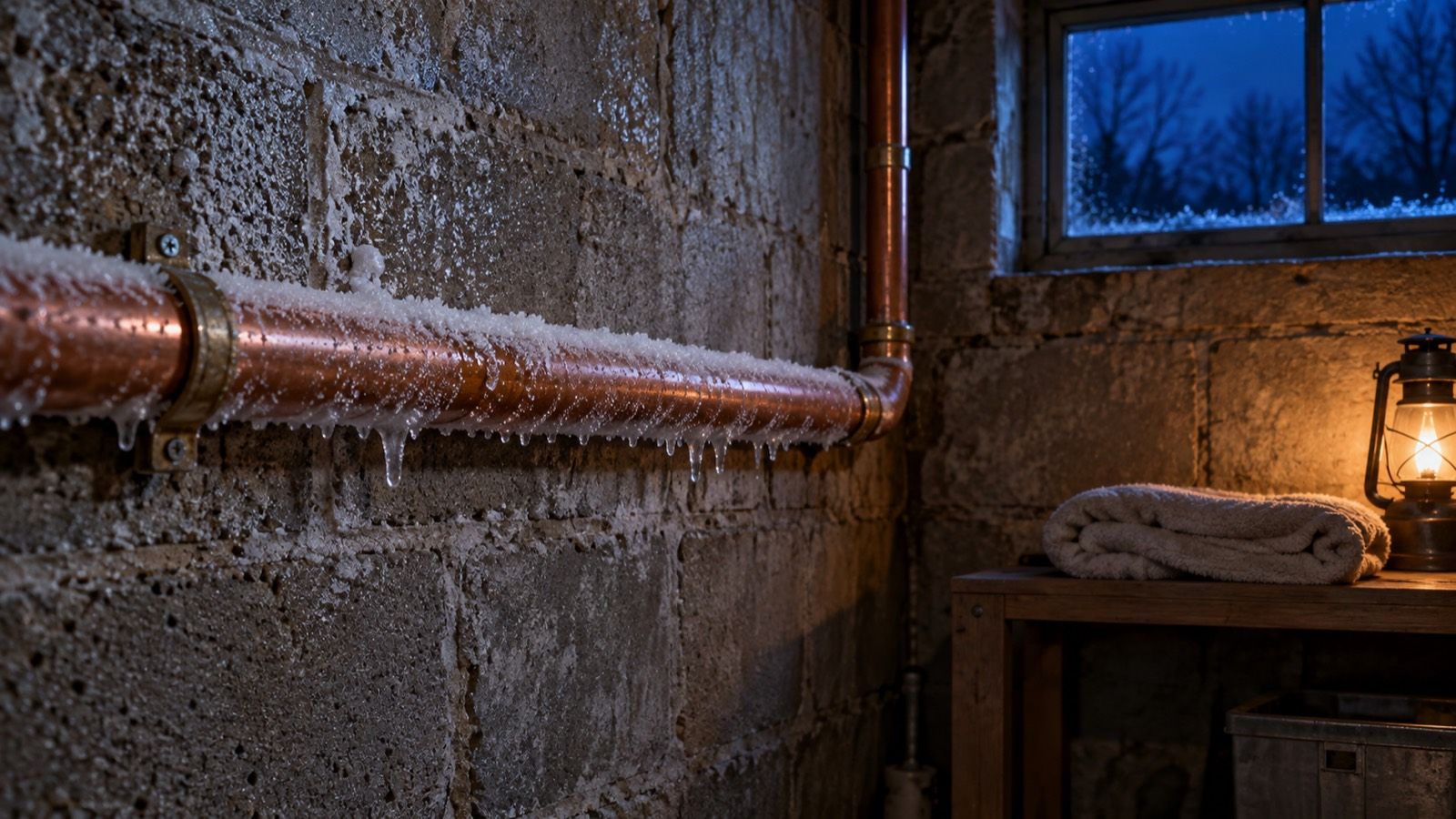
Key facts
| Fact | Value | Source |
|---|---|---|
| First sign of a frozen pipe | A faucet that gives only a trickle. Likely spots are pipes on exterior walls and where the water service enters through the foundation. | American Red Cross, Preventing & Thawing Frozen Pipes |
| Heat sources the Red Cross lists | Electric heating pad, electric hair dryer, portable space heater kept away from flammable materials, or towels soaked in hot water | American Red Cross, Preventing & Thawing Frozen Pipes |
| Heat sources the Red Cross bans | "Do not use a blowtorch, kerosene or propane heater, charcoal stove, or other open flame device." | American Red Cross, Preventing & Thawing Frozen Pipes |
| When to stop and call a licensed plumber | If you cannot find the frozen area, cannot reach it or cannot thaw the pipe | American Red Cross, Preventing & Thawing Frozen Pipes |
| First step if a pipe has burst | Turn off the main water supply, then call a plumber and drain the pipes | American Family Insurance, What to do when frozen pipes burst |
| Risk rises as the thaw arrives | Pipes that have frozen are more likely to leak or burst as temperatures thaw; Portland's water bureau took over 1,250 calls in about three and a half days in January 2024 | Portland Water Bureau, 2024-01-16 |
| Keep space heaters away from anything that can burn | At least 3 feet (about 0.9 m); December, January and February are the peak months for home heating fires | NFPA, Safety with heating equipment |
How do you know if your pipes are frozen?
A faucet that runs only a trickle is the sign the American Red Cross tells you to suspect first. Water expands as it freezes, and that pressure can break metal or plastic pipes.
Check the likely spots first. The Red Cross names pipes on exterior walls and the place where the water service enters through the foundation. It also lists unheated basements, crawl spaces, attics, garages and kitchen cabinets, plus outdoor hose bibs.
Then test every other faucet in the house. If one pipe freezes, others may be frozen too. To stop it happening again, see whether you should drip faucets.
What to do when pipes are frozen: the safe order
When pipes are frozen, open the faucet, warm the pipe slowly, and keep going until full water pressure returns. This is the Red Cross sequence.
- Leave the faucet open. As the ice melts, water starts to flow through the frozen section, and the moving water helps melt the rest.
- Warm the pipe with an approved heat source (table below).
- Keep applying heat until full pressure is back.
- Check every other faucet for more frozen pipes.
- Look along the thawed pipe for drips, damp walls or stains. The Portland Water Bureau says pipes that have frozen are more likely to leak or burst as temperatures thaw.
Call a licensed plumber if you cannot find the frozen area, cannot reach it or cannot thaw the pipe. The Red Cross gives those three conditions.
Which heat sources are safe for frozen pipes?
Hair dryers, heating pads and hot towels are the safe choices. Open flames are never acceptable. The table sorts every method named in the Red Cross, American Family Insurance and Portland guidance, plus the NFPA heater rule.
| Heat source | Verdict | What the sources say |
|---|---|---|
| Hot towels | Use | Red Cross and American Family Insurance both list towels soaked in hot water. Have several ready, because they cool fast. No electricity needed. |
| Electric hair dryer | Use, attended | Red Cross and American Family Insurance list it. Do not prop it on a chair, ladder or wall and walk away. Move the hot air around the pipe. |
| Electric heating pad | Use | Red Cross says wrap it around the pipe. |
| Heat lamp | Use with care | Portland names a hair dryer or heat lamp as safe ways to thaw pipes. |
| Portable space heater | Use with conditions | Red Cross says keep it away from flammable materials. NFPA says at least 3 ft (0.9 m) from anything that can burn and to switch it off when you leave the room. |
| Raising the thermostat | Use, slow | American Family Insurance suggests turning the heat up to get water moving again. |
| Heat tape or heat cable | Let a pro install | American Family Insurance says professionals may use these but should set them up, to keep water away from electricity. |
| Blowtorch, propane or kerosene heater, charcoal stove, any open flame | Never | Red Cross lists these by name. American Family Insurance says never, ever use an open flame. |
The pattern is consistent: the sources approve heat you can control and stay beside, and ban flame.
Can you use a hair dryer on frozen pipes?
Yes, a hair dryer is on the Red Cross list and the American Family Insurance list, and Portland recommends it too. Stay with it and keep the air moving along the pipe.
Keep the cord and dryer out of any water. American Family Insurance warns against letting water touch electricity and says to turn off the electricity to water-damaged areas of the home. If the pipe is already dripping, stop and shut the main first.
Can you thaw pipes during a power outage?
During a power outage, hot towels are the method that needs no electricity, but you still have to heat the water. A hair dryer, heating pad and space heater all need power.
A generator can run them, and it has to stay outside and away from the house. See how far a generator should be from your house. If you heat water on a gas stove, read using a gas stove or oven during a power outage first.
Do not use a propane heater or any flame on the pipe, even with the power out. The Red Cross bans them for thawing. For the indoor-use rules, see whether a propane heater is safe indoors.
Open cabinet doors under sinks and keep the house as warm as you safely can; how cold a house gets without heat shows how fast that window closes. Ways to stay warm without power lists safe options.
When should you shut off the main water valve?
Shut off the main water valve the moment a pipe leaks or bursts. American Family Insurance puts it first, and the Portland Water Bureau gives the same first step.
Use this path:
- Faucet gives only a trickle, no wet spots anywhere. Suspect a frozen pipe; a trickle alone does not confirm it. Keep the faucet open and thaw it as above. In the UK, the Met Office says the opposite order: turn off your inside stop tap immediately and thaw slowly with hot water bottles or hot towels.
- Water on a floor, a damp wall, a stain, or a bulge or sag in a ceiling. Treat it as a burst. American Family Insurance says a bulging or sagging ceiling is holding water and is not safe to stand under.
- Burst. Close the main valve. Portland also says to turn off the water heater and locate the dedicated shut-off valve on its cold-water inlet.
- Then drain. American Family Insurance says to open all cold taps, switch off the hot water heating system, open all hot taps and flush the toilets.
- Then call a plumber. If you rent or live in an apartment and cannot reach the shutoff, contact your landlord or property manager at once.
Find the valve before you need it. Portland says most are where the water line enters the house: at the front near the hose connection, in the basement near the water heater, or in the garage. Check the valve turns before a storm too; what to do before a winter storm covers the rest of the home checks.
If the pipe is frozen and the thaw is coming, stay close. Portland took over 1,250 calls for service between Saturday 13 January and midday Tuesday 16 January 2024, as a cold snap broke.
What to do after a pipe bursts: protect an insurance claim
After a burst, stop the water first, then contact your insurer before starting repairs. American Family Insurance says to call the agent once there is no danger and standing water is cleaned up.
American Family Insurance’s burst-pipe guidance gives these steps:
- Make note of every area where you see damage.
- Turn off the electricity to water-damaged areas where needed.
- Follow the claims department’s directions. If it tells you to wait on a step, wait.
- Clean up only what is safe: a wet/dry vacuum, towels, mops and a dehumidifier.
Ask your insurer what photos, receipts and other records it needs, and keep both before you clean up.
Common mistakes with frozen pipes
These are the errors the sources warn against:
- Using any open flame. The Red Cross and American Family Insurance both ban it.
- Leaving a hair dryer propped up and unattended. American Family Insurance says not to.
- Placing a space heater close to bedding, curtains or boxes. NFPA says keep 3 ft (0.9 m) clear.
- Shutting the faucet before the pipe thaws. The Red Cross method keeps it open.
- Stopping after one pipe. Check every faucet.
- Assuming it is over when the water returns. Portland says frozen pipes are more likely to leak as they thaw.
Frequently asked questions
Can you use a hair dryer on frozen pipes?
Yes. The Red Cross lists an electric hair dryer as a thawing method, and American Family Insurance adds that you should not prop it up and leave. Keep moving the hot air along the pipe so the heat spreads evenly. Do not use it where water is leaking or standing, because water and mains electricity are a shock risk.
How do you know if your pipes are frozen?
A faucet that gives only a trickle is the sign the Red Cross tells you to suspect. Check the pipes along exterior walls and where the water line enters through the foundation. Then test every other faucet, because if one pipe has frozen, others may have too.
Should you turn off the water if pipes are frozen?
In the US, not as the first step if nothing is leaking. The American Red Cross method keeps the faucet open so water can flow as the ice melts. Turn off the main valve as soon as a pipe leaks or bursts; American Family Insurance and the Portland Water Bureau both give that as the first action. In the UK, the Met Office says to turn off the inside stop tap as soon as you suspect a frozen pipe.
Will a frozen pipe always burst?
No. Water expands as it freezes, and the Red Cross says that can break metal or plastic pipes. American Family Insurance warns that a frozen pipe with no real warm-up coming may burst in time. Portland says frozen pipes are more likely to leak or burst as they thaw.
Can I use a propane heater or torch to thaw a pipe?
No. The Red Cross says not to use a blowtorch, kerosene or propane heater, charcoal stove or any other open flame device. American Family Insurance says never to use an open flame to thaw a pipe.
Sources
- Preventing & Thawing Frozen Pipes, American Red Cross (accessed 2026-10-26)
- What to do when frozen pipes burst, American Family Insurance (accessed 2026-10-26)
- What to do if water pipes freeze, leak, or burst as temperatures rise, Portland Water Bureau, City of Portland, 2024-01-16 (accessed 2026-10-26)
- Safety with heating equipment, National Fire Protection Association (accessed 2026-10-26)